
What to A/B Test First on a Product Page
Most stores run their A/B test roadmap backward. They test a button color for three weeks, get a result that means nothing at their traffic level, and never touch the one thing on the page that was actually costing them money.
What to a/b test first on a product page
Leverage is not spread evenly across a page. A test that changes how the offer is priced and packaged can move revenue per visitor by double digits. A test that changes a button from green to acid green almost never will, at the traffic most stores run. If you are asking what to a/b test first on a product page, the answer is the offer table, then the hero reframe, then everything downstream of that. Button colors go last, if they go at all.
Start with the offer table
Before you touch a headline or a photo, look at how the product is priced and packaged. Most product pages show one price and one button. That is not an offer, it is a price tag.
The offer table is where a real test starts because it is doing the least work relative to what it could do. A few things worth testing, roughly in the order we build them:
- A tiered choice with a decoy. Three options, shown in this order: the best value tier badged as such, a middle tier badged most popular, and a one time purchase shown small and unbadged. The one time option exists to make the other two look obviously smarter, not to be chosen.
- Unit economics beside every tier. Price per serving or per day next to each option. A large number shrinks when it is divided.
- A genuine struck through anchor price. The discount is the story, and it only works if the reference price is real, never invented.
- Value stacking instead of only discounting. Itemize what comes free, price each item, and total it against the cost.
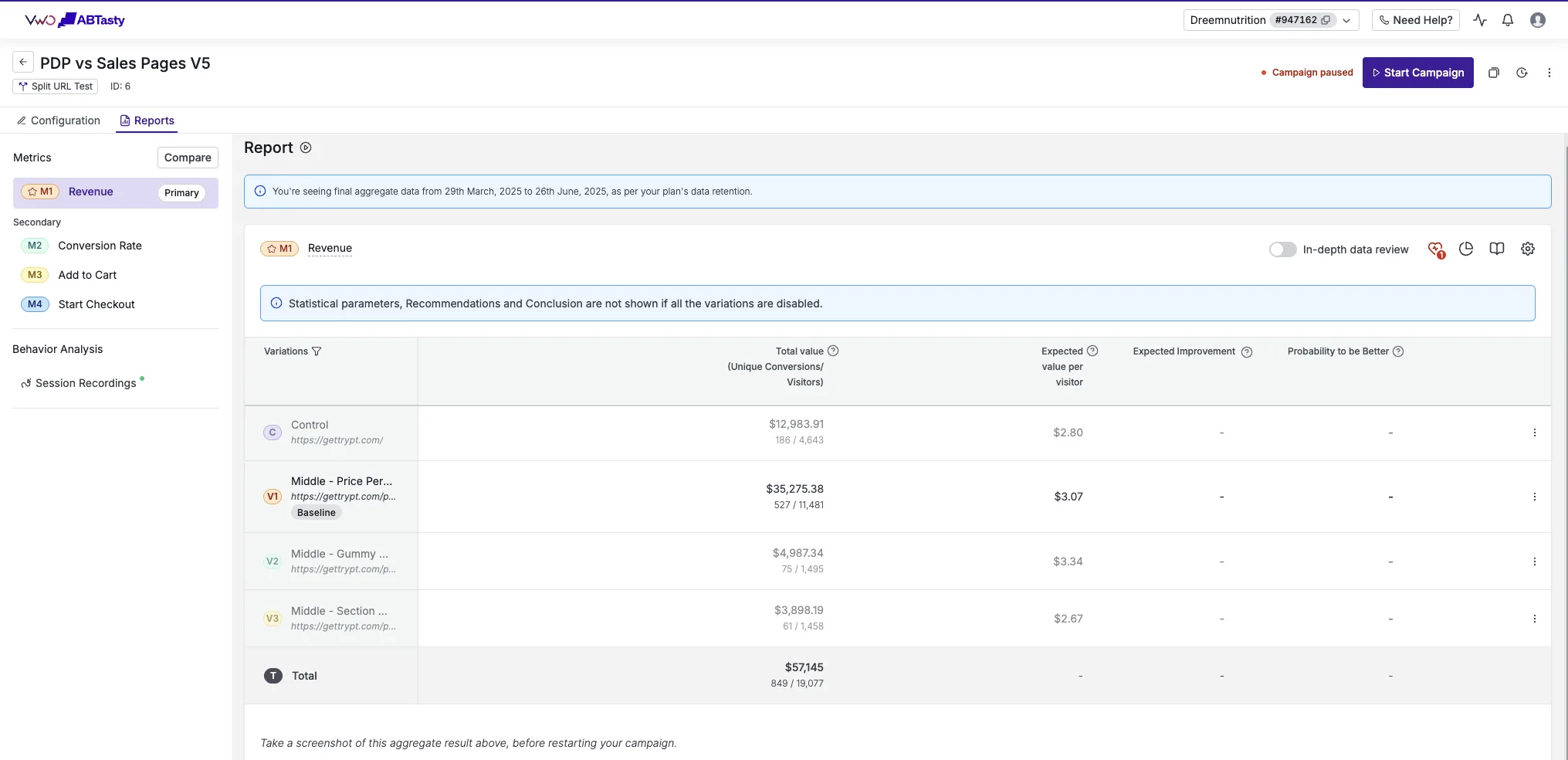
This is not decoration, it is the mechanism that decides how much of the page’s traffic converts and at what order value. Dreem Nutrition, a wellness gummy subscription, tested a rebuilt offer against their own product page on VWO with full metric tracking and measured a 25% lift in revenue per visitor.
Then the hero reframe
Once the offer is priced and packaged correctly, the next highest leverage test is what the page tells the visitor it is, before they scroll. Most product pages open by describing the product. A rebuilt page opens by stating what the product replaces or makes unnecessary. That single sentence at the top of the page is doing more work than any headline tweak below it.
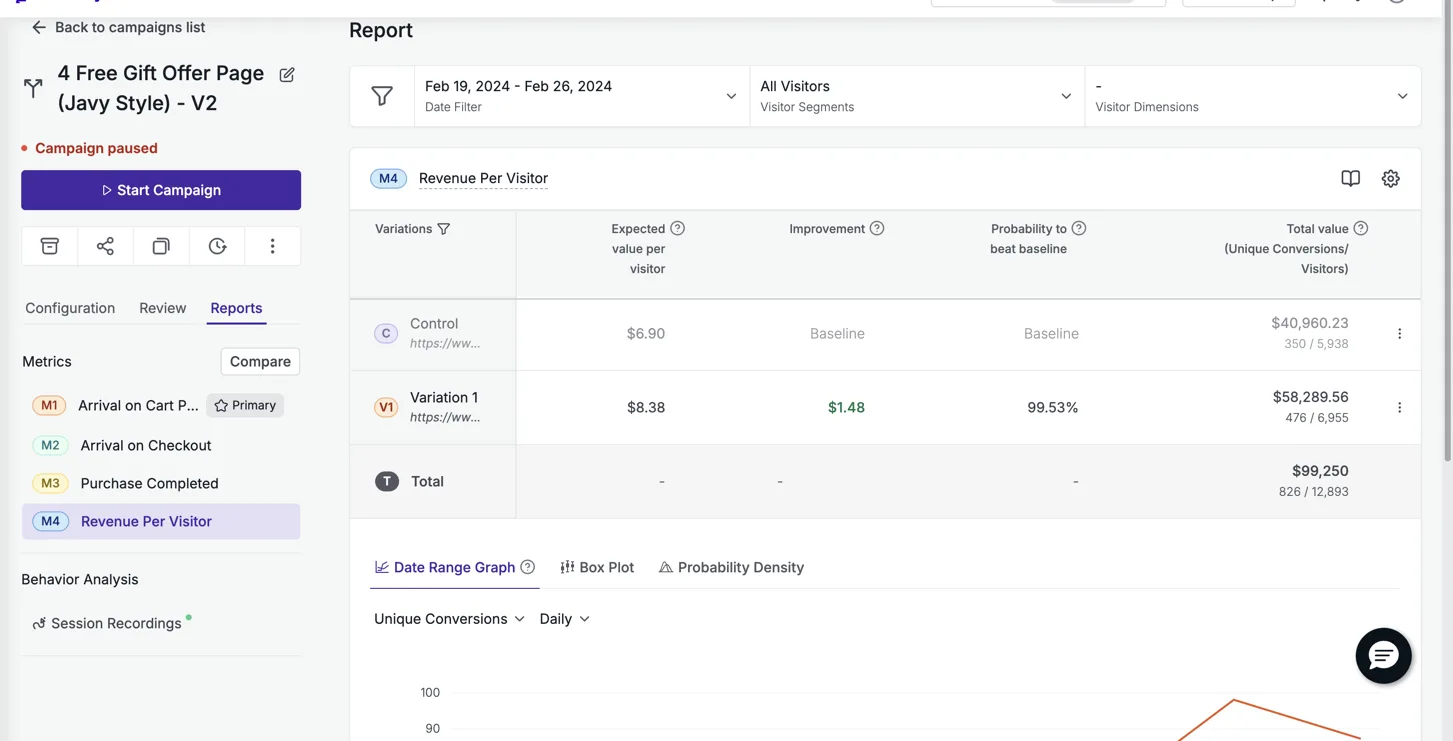
This is really a test of page type, not page copy. Particle for Men ran an offer page against their existing product page on VWO across 12,893 visitors and measured a 21.4% lift in revenue per visitor at 99.5% confidence. Two years later, the offer page is still live and still winning.
The offer table decides how much a visitor is willing to pay. The hero reframe decides whether they keep reading at all. Neither one is the button.
Proof placement, after the reframe is settled
Once the offer and the reframe are locked, the next lever is where proof sits on the page. Catalogue what the brand genuinely has: a founder story, an ambassador roster, real reviews, a clinical result, third party testing. Rank it by strength, then place the strongest piece above the fold or in the first scroll. Everything else earns the middle of the page. A brand with thin proof should run a shorter page, not a padded one.
This is a real test, and it is also where most rebuilt pages go wrong in the other direction: inventing proof that was not in the brand’s own material. A number that does not trace back to something the brand can show is the first thing a founder catches, and the fastest way to lose their trust in the whole rebuild.
Button colors, and why they come last
Single element changes, a button color, a badge word, a font weight, are close to noise at the traffic most stores run. They are not zero, they are just last. Test them after the offer table, the reframe, and proof placement are already working, when you are optimizing a page that is already winning rather than trying to fix one that is not.
The stores that skip straight to button colors are usually the ones that never tested the page type in the first place, sending paid traffic for one product to a home page or a broad collection and asking the visitor to do the work of finding what they came for. That is the biggest lever of all, and it sits above every test on this list.
Read significance, not just direction
A large lift on a small sample is a direction, not a result. Prime Natural measured a 307% lift in revenue per visitor on a small sample, and that is worth noting and worth retesting at scale, not worth declaring a permanent win off one read. Bareline, by contrast, ran its offer template against its existing template sitewide across 92,484 sessions and reached 99% probability to win with a 13.5% lift, which is a result you can actually build a decision on.
A winner that runs at full traffic for a long time will usually read lower later than it did in its controlled test. That is decay, not a lie about the original number, which is why the honest thing is to publish the controlled result with its methodology attached rather than a live dashboard months on. You can see the full set of measured results, methodology included, on /results/. If the offer table and the reframe are the parts you have not touched yet, that is also the order our page rebuild tests first.
See it on your own page.
We rebuild your highest-leverage page and prove the lift on your own live traffic. A 10% lift in conversion rate, or your money back.
Book a call