
Shopify Traffic But No Sales? Find The Real Leak
If you have shopify traffic but no sales, the instinct is to blame the ads, the audience, or the price. We look at hundreds of these situations a year, and the traffic is almost never the leak. The page the traffic lands on is.
We have worked with 400+ ecommerce brands, and the pattern repeats so often it stopped surprising us years ago. A brand spends real money getting a stranger to click, and then hands that stranger a page built to describe a product instead of a page built to sell it. The click was never the hard part. The fifteen seconds after the click is where the money dies.
Shopify Traffic But No Sales? Start Here
Before touching a single button or headline, look at what you are actually measuring. Most stores chase conversion rate, and conversion rate lies to you. You can lift it by pushing a cheaper product forward, running a coupon, or simplifying the offer down to nothing worth buying. The rate goes up. The business earns less per order.
We optimize for revenue per visitor instead, because it contains conversion rate and average order value at the same time. It cannot be gamed by a discount, since the discount lands inside the revenue number itself. Every result we publish is the new page against the brand’s own current page, split on their own live traffic, read straight from the A/B testing platform. Never ad platform reported revenue, which attributes generously and cannot see what the page actually did.
The Leak Is Usually Upstream Of The Page
The size of a win is mostly decided before anyone writes a headline. In order of how much it actually moves the number:
- What the visitor lands on. An ad for one product that lands on a home page or a broad collection makes the stranger do the work of finding what they clicked for. Most will not do that work.
- What kind of page it is. A product page describes a product. An offer page argues for buying it right now. These are different jobs, and they convert at different rates.
- How the page is built. Real, and the level most brands stop at, but a smaller lever than the two above.
- Single element changes. Button color, badge wording. At this scale, mostly noise.
Most teams start at the bottom of that list and work up, if they get to the top at all. We start at the top. That ordering alone is why Free the Roots saw revenue per visitor rise 33% when we tested an offer page against their collection page on Meta traffic. The collection page was never going to close a paid click, no matter what button sat on it.
The Offer Most Pages Never Actually Make
Here is the part a reader can act on tomorrow. Most Shopify product pages list a product. They do not make an offer. The two are not the same thing, and the gap between them is the single biggest lever we pull on a rebuild.
An offer page does a few specific things a plain PDP usually skips:
- Three pricing tiers, not one. Best value tier badged as such, a middle tier badged most popular, and a one time purchase shown small and unbadged on purpose. The one time option exists to make the other two look obviously smarter, not to get picked.
- Unit economics beside every tier. Price per serving or per day next to the total. Large numbers shrink the moment you divide them.
- A real anchor price, struck through. The discount has to trace back to a price that genuinely existed. An invented inflation is the first thing a sharp visitor spots.
- Value stacked, not just discounted. List what comes free, price each item, total it against the discount. Free items that out value the discount beat a deeper discount every time.
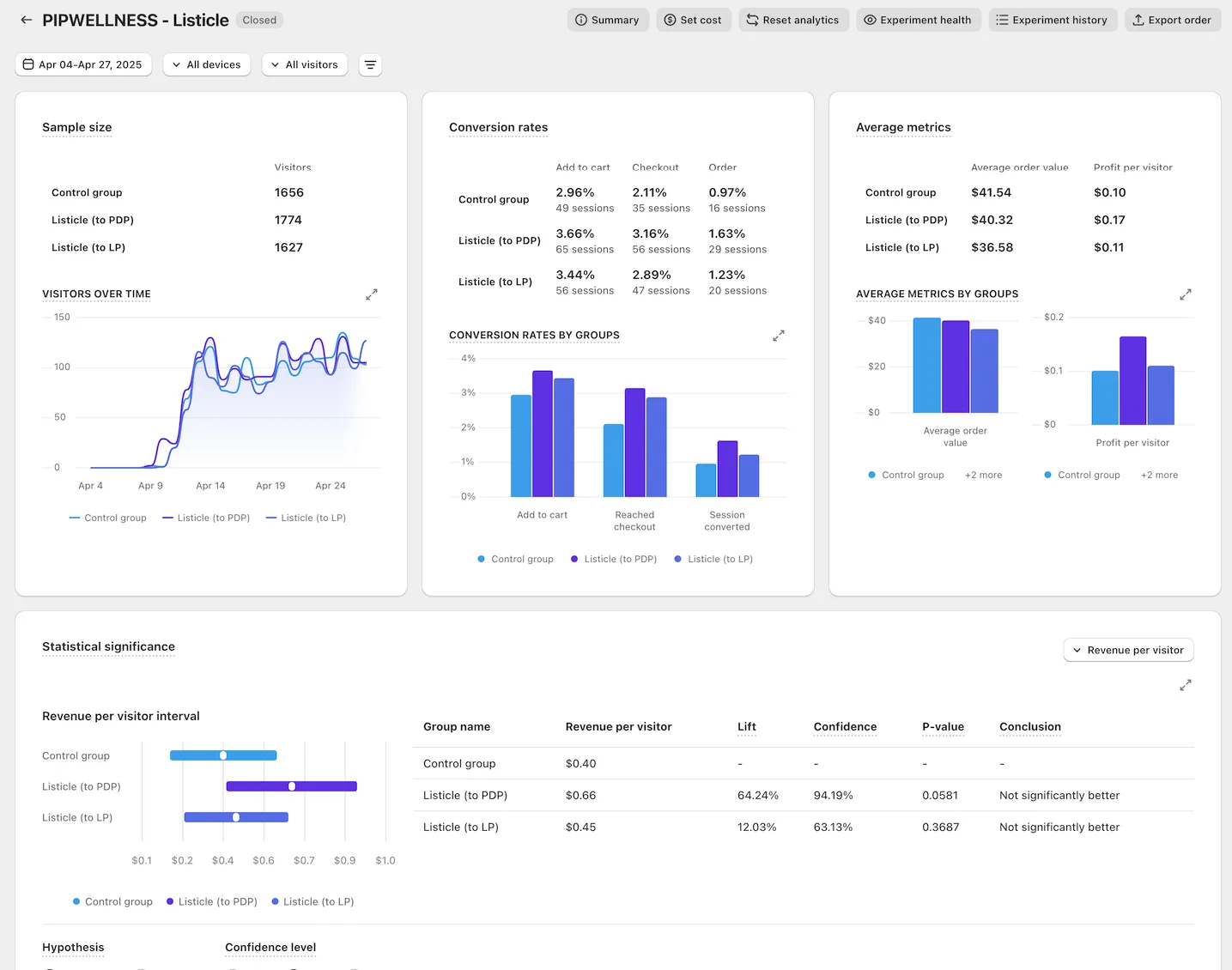
This is the mechanism behind Sonic Brush, where our page against their PDP moved revenue per visitor 24% on Google Ads traffic, and behind PIP Wellness, where a listicle style offer page against the control moved revenue per visitor 64%, from $0.40 to $0.66, on Meta traffic.
Proof, In The Right Order
A page with weak proof padded out with filler reads worse than a short page with real proof placed correctly. We catalogue what a brand genuinely has before writing a word, then layer it, strongest first: a credible founder story, real ambassador credentials, a scientific or medical advisory board, an actual clinical result with a registry link, third party testing, then volume and star ratings, then verified reviews.
The strongest proof a brand has belongs above the fold. Everything else is a supporting cast, not a substitute.
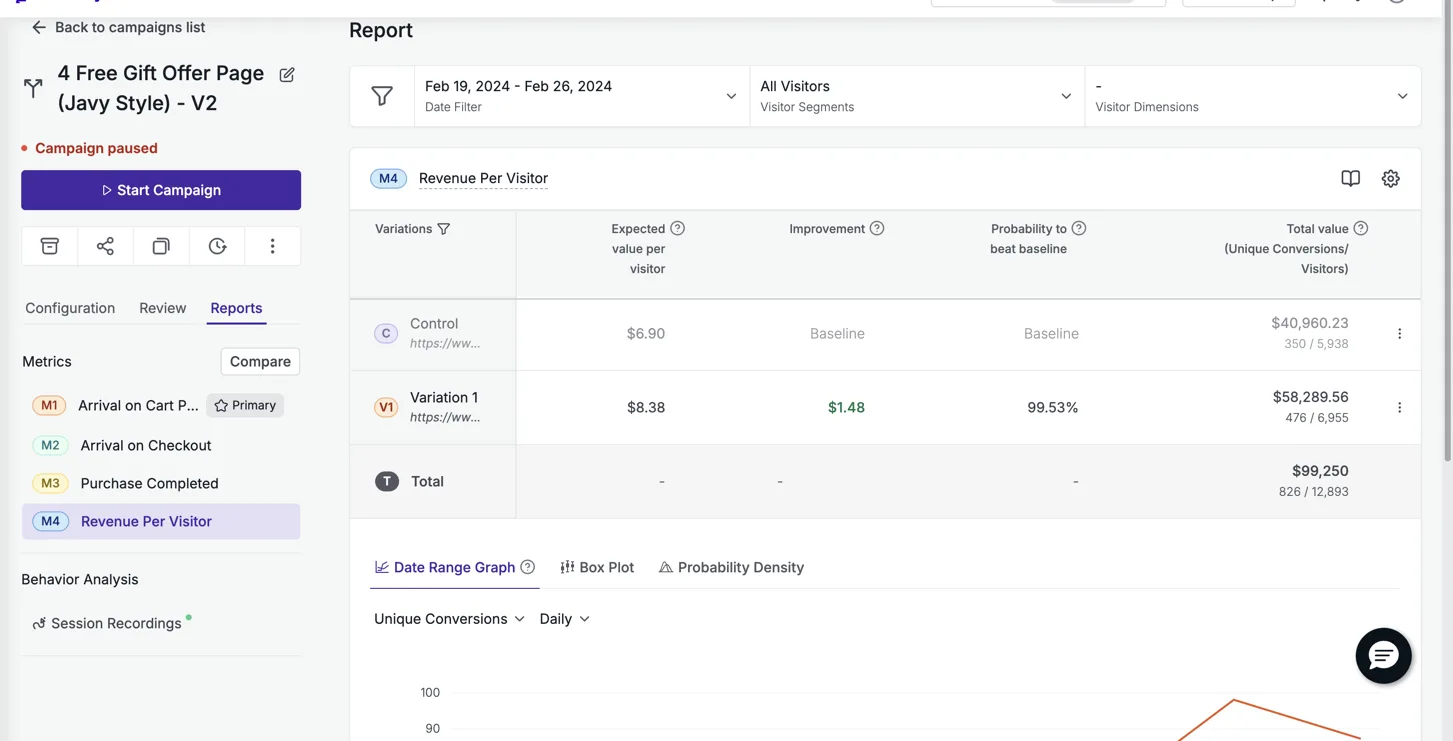
The rule of placement matters as much as the proof itself. Rating and volume proof sit beside the product title, where a visitor is already deciding. Deeper credibility, the clinical result, the advisory board, earns the middle of the page, where a visitor who is still reading has already shown intent. We never manufacture proof that is not there. If a brand has no clinical data, that section does not exist on the page. Particle for Men proved this without any invented proof at all: an offer page built entirely from what they actually had beat their PDP by 21.4% in revenue per visitor on VWO, at 99.5% confidence across 12,893 visitors, and it is still running two years later.
What We Actually Test, And What We Guarantee
We have exactly 15 measured, controlled test results we can point to, from Particle to Snuff Cup’s 310% lift on a small sample. That is a different number from the 400+ brands we have worked with, and we keep the two separate on purpose. A relationship count is not a test count, and treating them as the same thing is how a claim stops being trustworthy.
We rebuild a page for a flat $2,500 and test it against the brand’s current page on their own live traffic. If it does not lift revenue per visitor by 10%, in a controlled test read from the testing platform, it is a full refund, and we get up to five iterations to get there. You can see the full case list at /results/, and the exact terms of the guarantee at /guarantee/.
If you have shopify traffic but no sales, do not start with the button color. Start with what the visitor landed on, then what kind of page it is, then whether it actually makes an offer. The leak is almost always sitting upstream of where most teams go looking.
See it on your own page.
We rebuild your highest-leverage page and prove the lift on your own live traffic. A 10% lift in conversion rate, or your money back.
Book a call