
Is a Product Page Redesign Worth It? Do the Math
Is a product page redesign worth it. That is the question most founders ask right before they spend a few thousand dollars on new photography and a cleaner layout. The honest answer is it depends what you redesign, and in what order. We have run fifteen measured tests against real product pages, and the biggest wins rarely came from making the existing page prettier. They came from changing what the visitor landed on, or what job the page was doing in the first place. Here is the actual math, and the method behind it.
Is a product page redesign worth it, or is it the wrong page
Before anyone touches fonts or photography, ask what the visitor landed on. An ad promising one product that lands on a home page or a broad collection makes the visitor hunt for what they came for. Most will not bother. That single mismatch, not the page’s design, is often the entire leak.
The size of a win is mostly decided before anyone opens a design tool. In order of how much it actually moves revenue per visitor:
- What the visitor lands on. A dedicated page for the exact thing the ad promised, or a home page and hoping.
- What kind of page it is. A product page describes a product. An offer page argues for buying it now. Different jobs, different conversion.
- How the page itself is built. Real, and where most redesigns live, but a smaller lever than the two above.
- Single element changes. Button color, badge wording. Close to noise at this scale.
A redesign that only touches layer three, the build, while leaving layers one and two untouched, is capping its own upside before it starts.
The offer page beats the product page
This is the part a straight redesign usually misses. A product page’s job is to describe. An offer page’s job is to make the case for buying right now, with the pricing, the proof, and the urgency all doing work toward one decision. Swapping a product page for a genuine offer page is a different kind of change than a redesign, and it is where our largest numbers come from.
Particle for Men ran their offer page against their own product page on VWO, and it won by 21.4% in revenue per visitor at 99.5% confidence across 12,893 visitors. That page is still live two years later, which matters more than the headline number, because a number that only holds for a week is not a result.
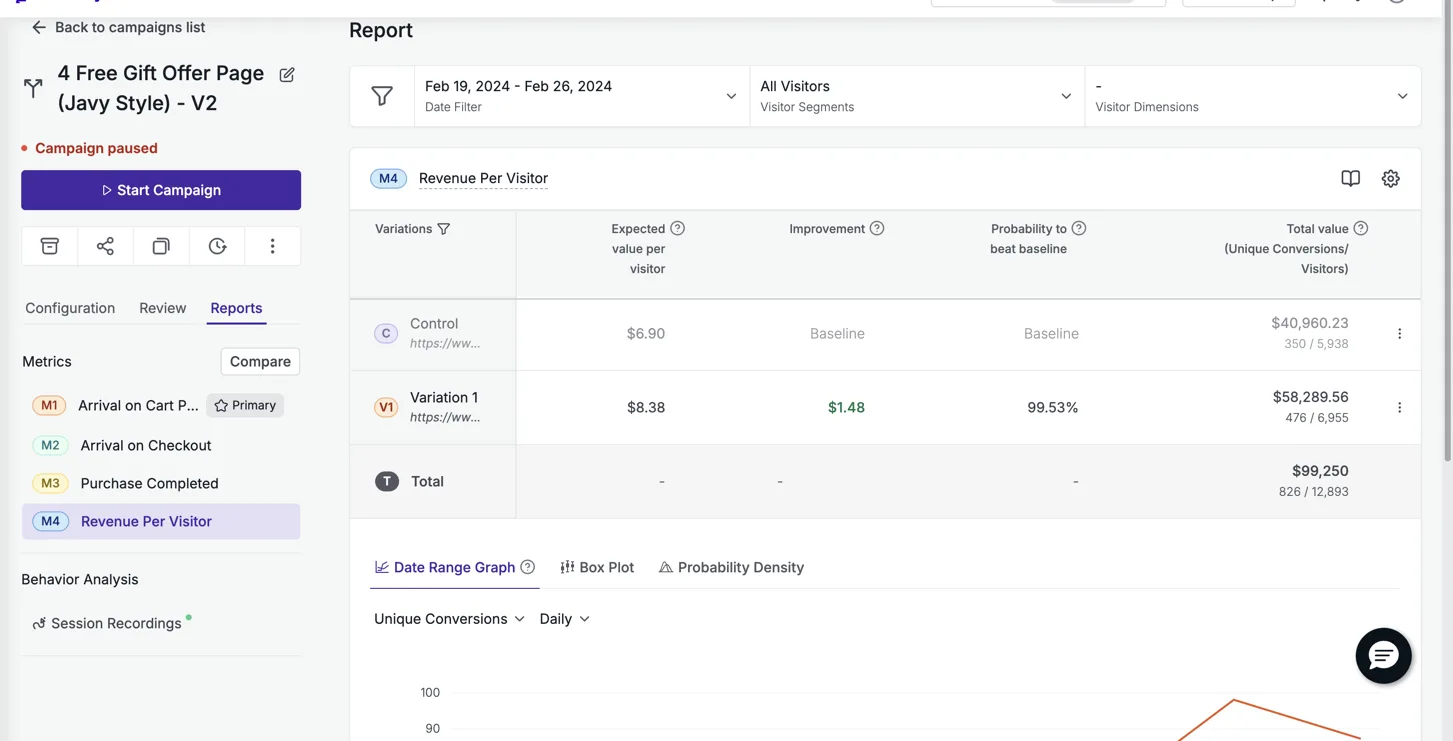
DuraDry ran the same shape of test on Google Ads traffic through VWO and saw 45%. Legendary Car Care ran it on Meta traffic through ABConvert and saw 32%. Three different verticals, three different testing platforms, the same lever.
The offer architecture most redesigns skip
Here is something you can act on tomorrow, not just a stat to admire. Most redesigns rebuild the photography and the layout, then leave the actual offer exactly as it was. That is the expensive mistake.
An offer page that is doing its job usually has:
- Tiered choice with a decoy. Three options in view. The best value tier badged as such, a middle tier badged most popular, and a one time option shown small and unbadged, there mainly to make the other two look like the obvious smart choice.
- Unit economics next to the price. Price per serving, per day, per use, right beside every tier. Big numbers shrink fast once you divide them.
- A genuine struck through anchor price. The discount is the story, but the reference price has to be real. An invented inflation is the first thing a sharp visitor notices.
- Value stacked, not just discounted. List what comes free, price each piece, total it against the discount. Free things that out value a deeper discount beat a deeper discount.
- The trust cluster repeated under every buy button. Guarantee, shipping, cancel anytime, each in three words with an icon.
None of that requires new photography. It requires rebuilding the actual argument for buying, which is the part a cosmetic redesign leaves untouched.
What the fifteen measured results actually show
We have worked with 400+ ecommerce brands over the years. Fifteen of those, listed with real names and real numbers on our results page, are controlled tests we can point to directly. That distinction matters: a redesign someone liked and a redesign that moved revenue per visitor in a controlled test are not the same claim.
Across those fifteen, the range is wide. Sonic Brush saw 24% running our product page against their own on Google Ads traffic. Free the Roots saw 33% running an offer page against a collection page on Meta traffic. PIP Wellness ran a listicle style page against their control on Meta traffic and saw 64%, moving revenue per visitor from $0.40 to $0.66.
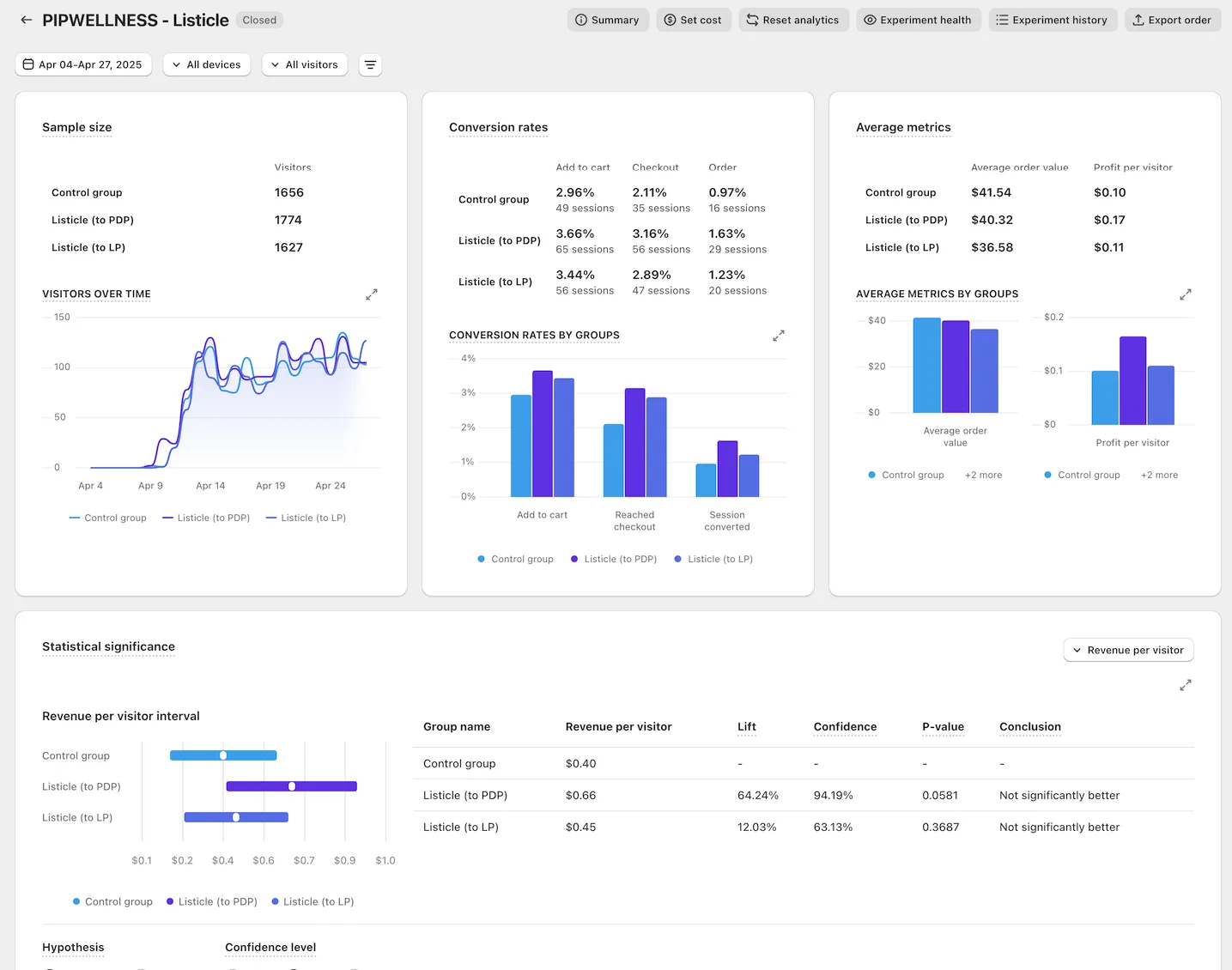
The page that wins is the one that argues for the sale, not the one that just describes the product.
How to read a result without fooling yourself
Two of our fifteen results, Prime Natural at 307% and Snuff Cup at 310%, are enormous and honestly labeled as small samples. A huge lift on a small sample is a direction worth acting on, not proof of what will happen at scale. Read significance, not just the size of the number. Bareline’s 13.5% ran across 92,484 sessions at 99% probability to win, which is a smaller number carrying more weight than either of the triple digit ones.
And remember that a winner decays. A page that beats the control in a controlled test, then runs at full traffic for a long stretch afterward, will usually read lower months later than it did on day one. That is not the original result lying to you, it is decay, which is exactly why the number worth publishing is the one from the controlled test, with its methodology attached, not whatever the dashboard shows a year in.
If you want to see whether a rebuild is worth it for your own page, that is the actual math: what page the visitor lands on, whether it is arguing or just describing, and whether the number that convinces you is significant or just big. We back our own rebuilds with a 10% lift guarantee in a controlled test, or the work is free.
See it on your own page.
We rebuild your highest-leverage page and prove the lift on your own live traffic. A 10% lift in conversion rate, or your money back.
Book a call