
How to Build a Product Page That Keeps Converting Over Time
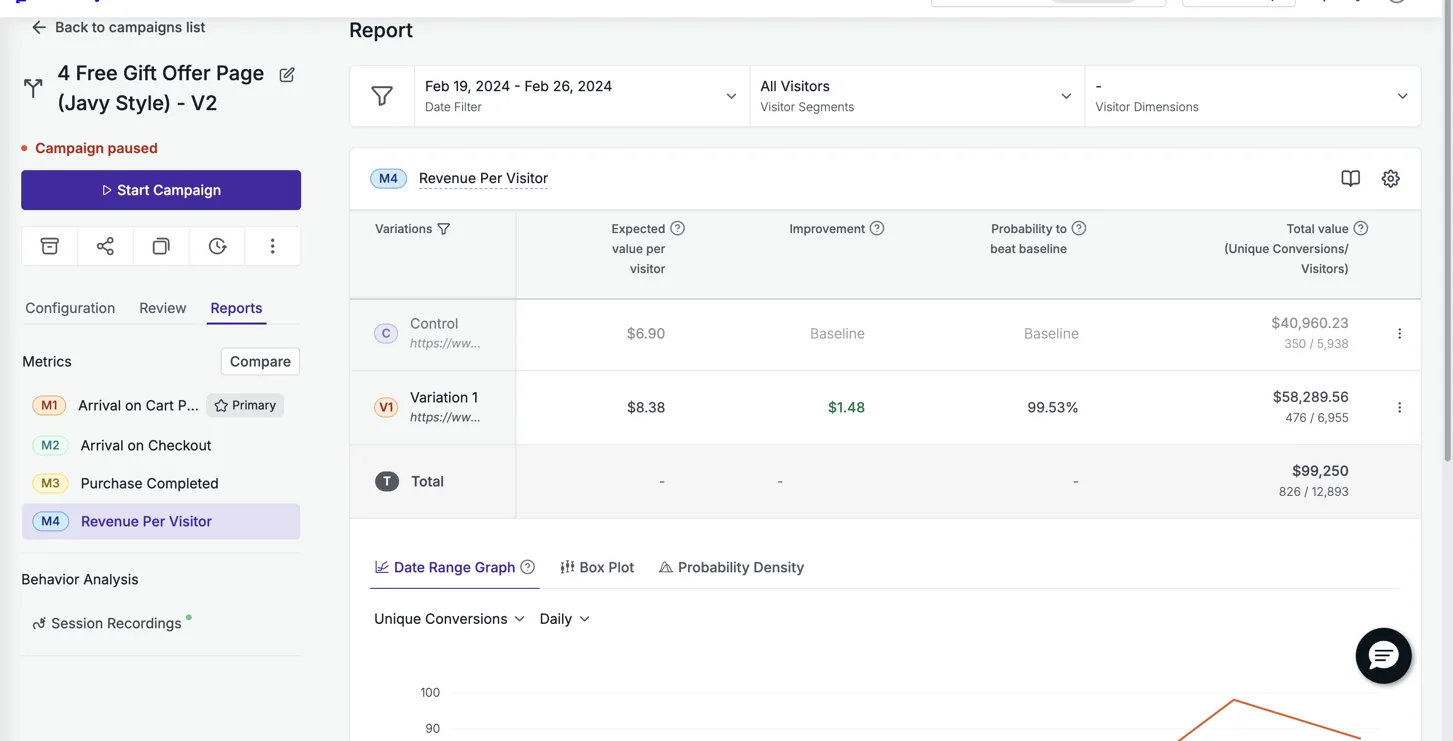
Particle for Men's offer page beat their product page by 21.4% in revenue per visitor, in a controlled test, two years ago. It is still the live page today, never swapped out or quietly reverted to the original product page. That makes it the clearest example we have of how to build a product page that keeps converting over time, because most rebuilt pages do not hold their lift anywhere near that long.
How to build a product page that keeps converting over time
Most rebuilt pages do decay. A winner that ran at half of traffic in a test and then goes live at full traffic usually reads lower a few months later than it did on test day. That is not a lie about the original number. It is what happens when a page’s lift depended on something that fades: a seasonal urgency line, a discount that stops feeling special once everyone has seen it, a visual trick that worked only because it was new. The honest response is publishing the controlled number with its method attached, which is what we do for every result on /results/, and building the next page so its lift depends on less of that.
Particle’s page did not decay because its lift came from structure, not a trick. It was tested as an offer page against their existing product page, on VWO, at 99.5% confidence across 12,893 visitors. That is a real sample taken over real time, not a lucky week. What was being tested was the architecture of the page itself, what it argues and in what order and backed by what proof. Architecture does not go stale the way a countdown timer does.
The decay you can see coming
Two of our own results sit at the opposite end of this risk. Prime Natural lifted revenue per visitor by 307%, and Snuff Cup by 310%, both on small samples. Those are real, directional wins, and we say so plainly rather than dressing them up as settled. A result like that is a strong early read, not a number to build a two year forecast on. The Particle number earns more trust precisely because the sample was large enough that 99.5% confidence actually means something.
What actually holds up
A few structural choices separate a page that is still winning in year two from one that needs a rebuild every quarter.
- The offer argues, it does not just display. A product page describes a product. An offer page makes the case for buying it now, for a reason that stays true regardless of the calendar.
- Proof is layered, not borrowed. Founder credibility, review volume, real testing, named outcomes. Whatever is actually true about the brand, stacked in order of strength, never manufactured and never carried over from somebody else’s page.
- The pricing table does the persuading, not the discount. A struck through price has to be a genuine reference point. Unit economics, price per use or per day, shrink a number that looks large on its own, and that math does not stop being true next year.
The pages that keep converting are the ones built to argue a case, not the ones built to catch an eye.
Test the structure, not the paint
When we read a result, we read revenue per visitor alongside conversion rate on purpose. Conversion rate alone can be moved by pushing a cheaper item forward or running a coupon, and the page then wins on the metric it is measured by while the business earns less per order. Revenue per visitor holds conversion rate and order value at once, which is why every number we publish, including Particle’s 21.4%, Bareline’s 13.5%, and Free the Roots’ 33%, is read that way.
This is also why the single highest leverage thing to get right is not a button color or a badge wording. It is what kind of page the visitor lands on and what that page is actually arguing. A rebuild that only changes surface elements is testing paint. A rebuild that changes the architecture is testing the thing that actually holds a lift over time.
What we guarantee, and why durability matters to it
Our offer is a flat fee rebuild, once, not a retainer, with a guarantee: a 10% lift in conversion rate in a controlled test, or your money back, across up to five test iterations if needed. The full terms are on /guarantee/. Durability belongs in that conversation because the same structural choices that keep a page from decaying are the ones most likely to clear that bar in the first place. A page engineered to hold its lift over two years is also the page most likely to produce a real one on day one, rather than a number that only looked real for a week.
We have worked with 400+ ecommerce brands. Particle’s rebuild happens to be the one that has had the longest to prove whether a lift actually holds, and two years in, it still does.
See it on your own page.
We rebuild your highest-leverage page and prove the lift on your own live traffic. A 10% lift in conversion rate, or your money back.
Book a call