
Why Your Redesign Lowered Conversion Rate
A redesign is supposed to help. New fonts, new photography, a cleaner grid, and then the numbers come in lower than before. If you are trying to figure out why redesign lowered conversion rate on your own store, the honest answer is usually not the redesign itself. It is that the redesign changed the wrong thing.
Why redesign lowered conversion rate in the first place
Most redesigns are a visual pass on the page you already had. Same product page, same job, nicer execution. That is the smallest lever available, and pulling the smallest lever while leaving the bigger ones untouched can easily make things worse, because a new layout with the same weak argument just makes the weak argument look more confident.
There is a rough order to how much each layer of a page actually controls the result:
- What the visitor lands on. An ad for one product sending traffic to a home page or a broad collection makes the visitor do the work of finding what they came for. Most will not bother.
- What kind of page it is. A product page describes a product. An offer page argues for buying it now. These do different jobs and they convert differently.
- How the page itself is built. Real, but smaller than the two above.
- Single element changes. Button color, badge wording. Close to noise at this scale.
A typical redesign lives entirely in the third bucket. It rebuilds the page without ever asking whether it is the right kind of page, or whether the visitor should be landing there at all.
The redesign fixed the wrong layer
Here is the pattern we see constantly: a brand pays for a redesign of their product page. The new version is better designed by any visual standard. It still loses, or barely holds even, because it is still a product page doing a product page’s job, spec sheet, gallery, reviews, when the traffic arriving on it needs to be sold, not informed.
An offer page argues. It states the reframe, stacks the proof, anchors a real price against a real reference price, and closes with a trust cluster under every buy button. A product page assumes the visitor already decided. Cold traffic has not decided anything yet.
A redesign that changes how a page looks while leaving what kind of page it is untouched is not a redesign, it is a paint job.
This is the single biggest reason a redesign can lower conversion rate instead of raising it. The new page photographs better in a screenshot and still argues nothing.
What actually moved revenue per visitor
We do not guess at this. Every number below is the new page against the brand’s own current page, split on their own live traffic, read from the A/B testing platform, never ad platform reported revenue. We optimize for revenue per visitor, not conversion rate alone, because revenue per visitor contains conversion rate and average order value at once and cannot be gamed by a discount that sells more units at a worse margin.
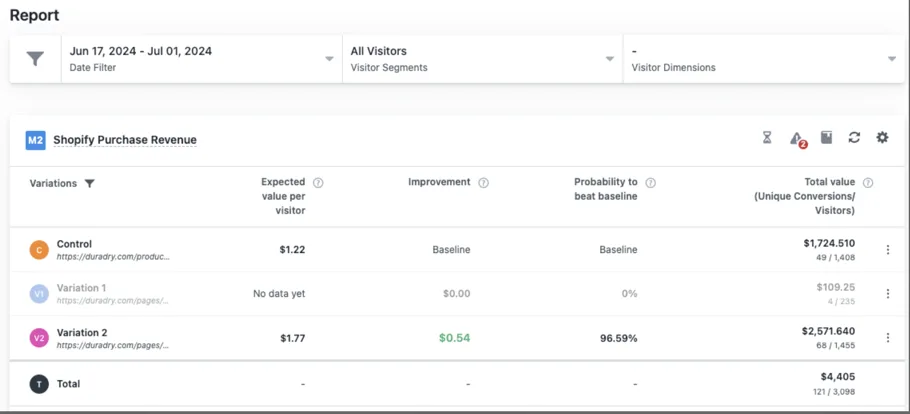
DuraDry replaced their product page with an offer page and ran it against their own PDP on Google Ads traffic in VWO for two weeks. Revenue per visitor rose 45%.
Eiyan Lens tested an offer page against their own home page on Google Ads traffic in ABConvert and saw revenue per visitor rise 52%. Particle for Men has run an offer page against their PDP for two years, 99.5% confidence across 12,893 visitors, and it is still live because it still wins. Legendary Car Care saw 32%, Free the Roots saw 33%, Sonic Brush saw 24%, all offer or rebuilt pages against the original, all read the same way, from the testing platform, not from a hunch. Full detail on every case is on /results/.
The offer architecture most redesigns skip
This is the part that is easy to leave out of a visual redesign, and it is usually where the revenue actually comes from.
Price a tiered choice, with a decoy. Three options, in visual order: the best value tier badged as such, a middle tier badged most popular, and a one time purchase shown small and unbadged. The one time option is not there to be chosen. It exists so the other two look obviously smarter by comparison.
Anchor with a real struck through price. The discount has to be honest, not an inflated reference number invented to make the markdown look bigger. Show the unit price everywhere. Price per serving or per day next to every tier. A big number shrinks fast once it is divided.
Stack value instead of only discounting deeper. Itemize what comes free, price each item, total it against the cost. Free additions that out value a discount beat a bigger discount every time.
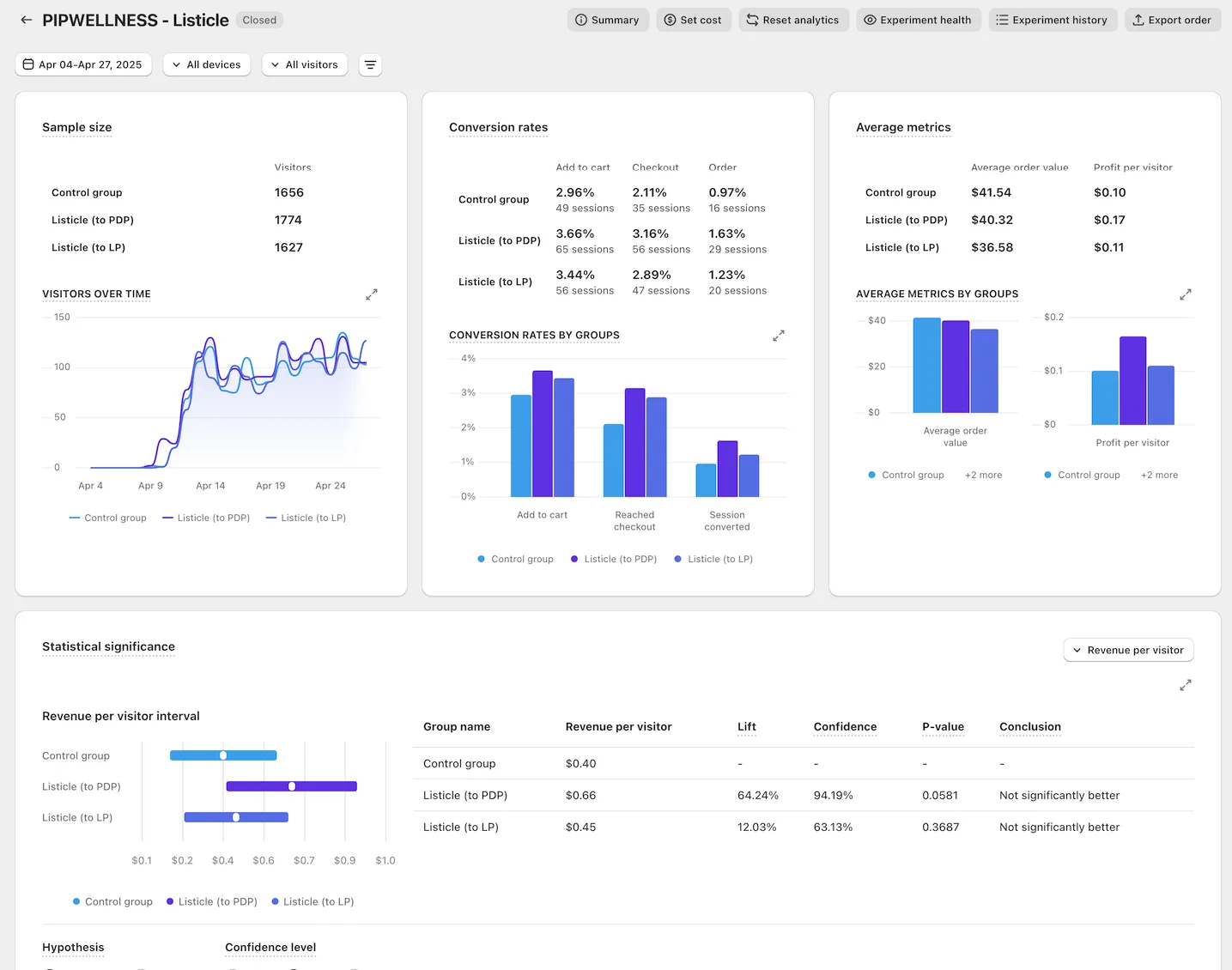
PIP Wellness ran a listicle style page against their own PDP as the control on Meta traffic in ABConvert. Revenue per visitor went from $0.40 to $0.66, a 64% lift.
Proof matters just as much as pricing, and the order it appears in matters too. Catalogue what the brand genuinely has: a founder story, a real ambassador, a scientific board, an actual clinical result, third party testing, review volume. Put the strongest true proof above the fold or in the first scroll. Never invent a number, a review count, or a claim that is not real. A thin proof stack should make the page shorter, not padded with filler.
How to test a redesign instead of guessing at it
A redesign that ships without a test is a bet, not a decision. Read significance, not just direction. A big lift on a small sample is a direction, not a conclusion, and should be described that way rather than sold as proof. Prime Natural saw 307% on a small sample, a real number worth watching, not yet a settled result the way Bareline’s 13.5% is at 99% probability to win across 92,484 sessions.
The cleanest way to find out if a redesign will actually raise revenue per visitor is to run it against the page you already have, on your own traffic, and read the real number. That is the whole model behind our guarantee, a rebuilt page at one flat fee, and a 10% revenue per visitor lift in a controlled test or your money back.
See it on your own page.
We rebuild your highest-leverage page and prove the lift on your own live traffic. A 10% lift in conversion rate, or your money back.
Book a call