
What Shopify AB Test Conversion Rate Results Actually Prove
A before and after screenshot is not a Shopify AB test conversion rate result, it is a guess wearing a lab coat. Traffic moves week to week, ad spend changes, a competitor runs a sale, and none of that shows up in two screenshots taken a month apart. A real test runs two pages against each other, on the same traffic, at the same time, and reads the result through a testing platform that can tell you how much to trust the number. We have run 17 of these, each one against the brand's own live page, and the spread between them is the whole lesson.
Shopify AB Test Conversion Rate Results: Confidence Versus Sample Size
Every result on our /results page is read the same way: new page against current page, split on real traffic, reported by the testing platform rather than estimated from ad dashboards. But the number on its own tells you nothing until you know two other things, how many visitors saw it and how confident the platform is that the difference is real and not noise.
Particle for Men ran its offer page against its product page on 12,893 visitors through VWO and came back at 99.5% confidence with a +21.4% lift in revenue per visitor. That page is still live two years later, which is its own kind of proof, a result that was real enough to survive two years of real traffic instead of decaying the way a lot of winners do.
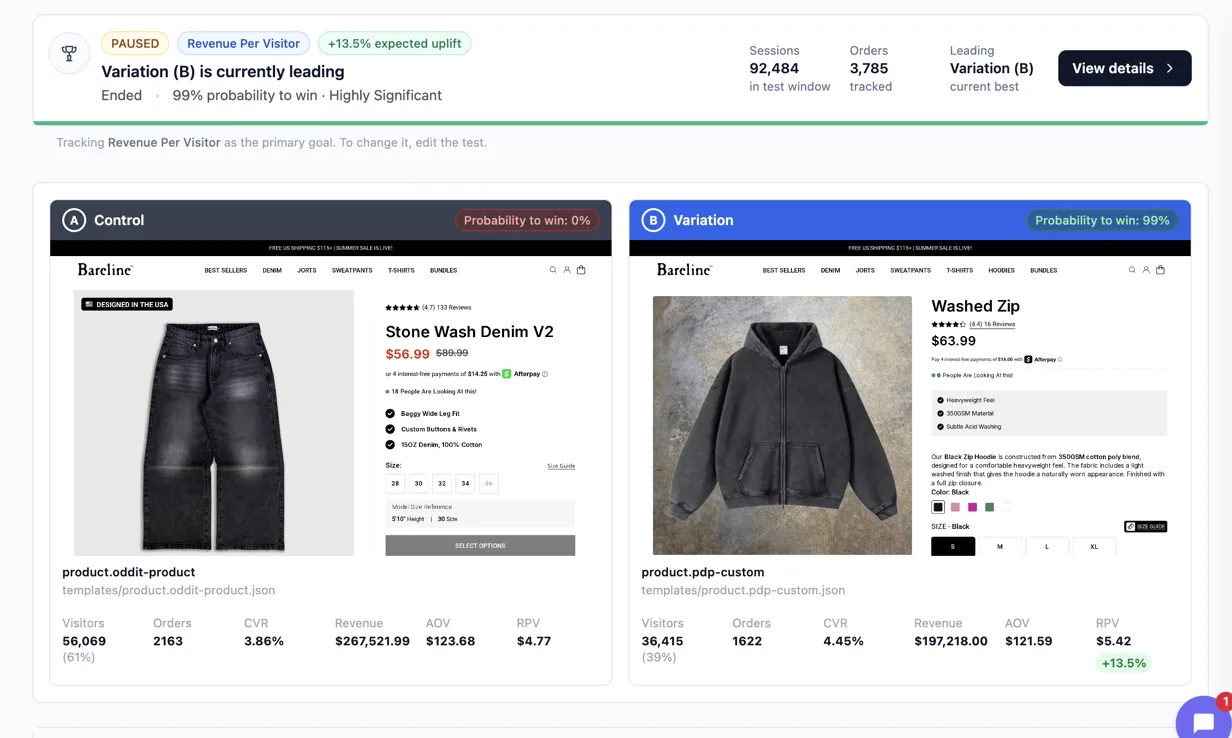
Bareline tested a product page template against its own template across 92,484 sessions and came back 99% probability to win, a +13.5% lift in revenue per visitor. Daily Sale ran 75,300 visitors through its test and hit 100% probability to beat the control at +63%. These are the results worth building a decision on. Big samples, high confidence, and the platform itself telling you the gap is real.
Why A Big Number On A Small Sample Is A Direction, Not A Result
Prime Natural and Snuff Cup both show up in our case list at +307% and +310%. Those are real numbers off a real test, but we label them the way we would want a vendor to label them to us: small sample, big result. A lift that large, on a small audience, is a strong signal worth acting on. It is not the same claim as Bareline’s +13.5% across 92,484 sessions, and treating it the same way is how a store owner ends up disappointed a month later when the number settles.
A large lift on a small sample is a direction, not a result, and the honest thing to do is say so before someone builds a forecast on it.
This is also why a winner that has run at full traffic for a long time will often read lower later than it did inside its own controlled test. That is not the original number lying to you, it is decay, the normal drift of a result once it stops being measured against a live control and starts absorbing every seasonal swing on its own. The fix is not to distrust the original test. It is to publish the controlled number with its method attached, which is exactly why every figure on /results names its traffic source and its platform.
The Metric That Catches A Fake Conversion Rate Win
Here is the part most Shopify AB test conversion rate results skip. Conversion rate on its own can be gamed. Push a cheaper product forward, run a coupon, and the rate climbs while the business earns less per order. So every test we run is also read in revenue per visitor, total revenue divided by total visitors, which holds conversion rate and average order value at once. A page that lifts conversion rate and drops revenue per visitor has not won anything. Billy Bones Club is our one case measured directly in conversion rate, +10.5% against its own template across sitewide traffic over about three weeks, with the brand’s own team iterating alongside us, which is why we read that one as directional rather than final. Every other case on our list is revenue per visitor precisely because it is the harder number to fake.
What To Check Before You Trust Your Own Test
If you are reading your own Shopify test results, run through this before you act on them.
- What does the platform say the confidence or probability to win actually is, not just the percentage lift.
- How many visitors or sessions were in the test. A few hundred is a hint. Tens of thousands is a result.
- Did revenue per visitor move with conversion rate, or did one go up while the other went flat or fell.
- How long has the winner been live at full traffic since the test ended, since that is when decay shows up.
A controlled test with real traffic behind it is the only version of this that holds up when someone checks your work. That is the standard our guarantee is built on, a 10% lift in conversion rate in a controlled test or the engagement is refunded, because a result that cannot survive scrutiny was never a result.
See it on your own page.
We rebuild your highest-leverage page and prove the lift on your own live traffic. A 10% lift in conversion rate, or your money back.
Book a call