
What a Product Page Rebuild Does to Revenue Per Visitor
A product page rebuild does one thing: it changes what happens after the click, and that shows up as revenue per visitor, not conversion rate. That is the number worth watching if you are asking what a product page rebuild does to revenue per visitor, because it is the only one that counts a discount, an upsell, and a bounce in the same measurement.
What a product page rebuild does to revenue per visitor
Revenue per visitor is total revenue divided by total visitors. It contains conversion rate and average order value at once, which means it cannot be gamed by a discount, a cheaper bestseller pushed to the front, or a coupon that wins on conversion rate while the business earns less per order. Every result here is the new page against the brand’s current page, split on their own live traffic, read from the A/B testing platform. Never ad platform reported revenue, which attributes generously and cannot see what the page actually did.
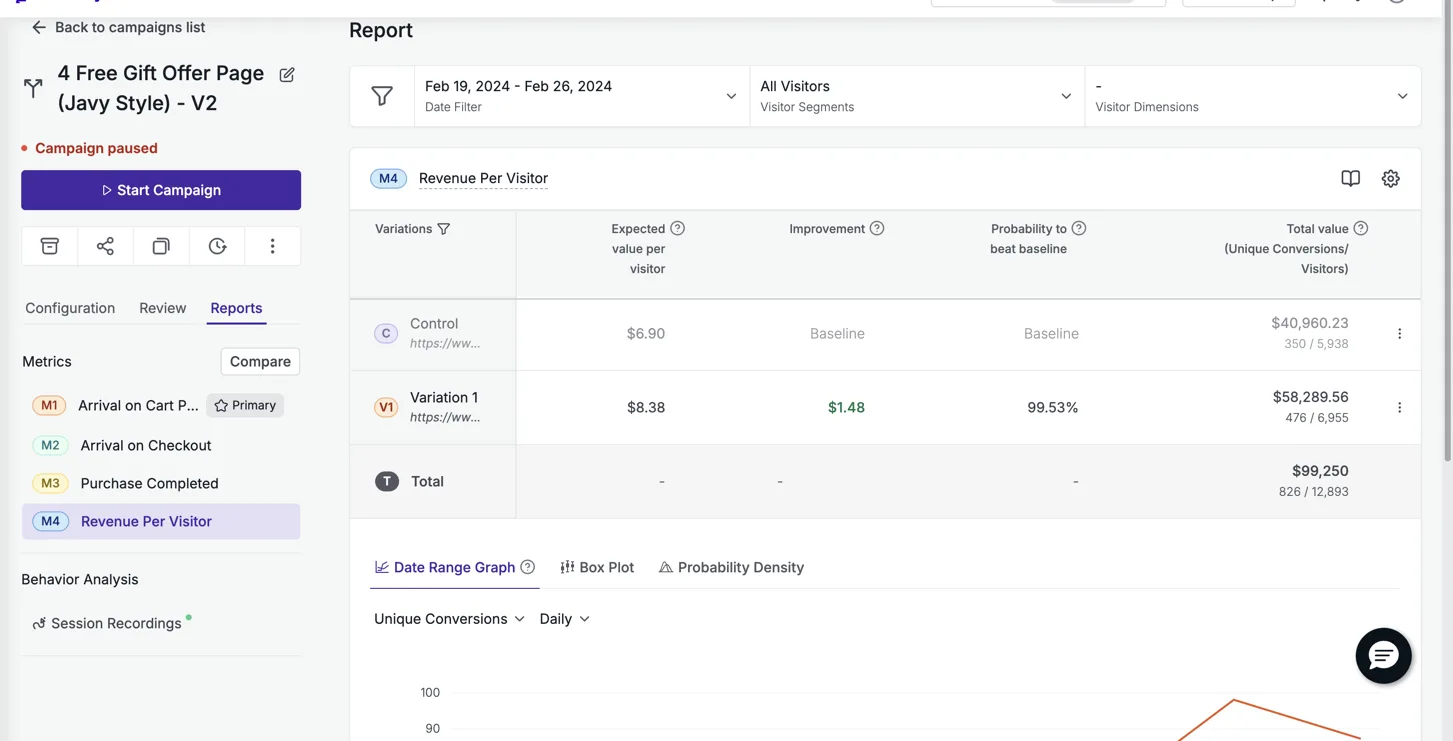
Particle for Men ran an offer page against their existing product page on VWO, 99.5% confidence across 12,893 visitors, and came back +21.4% revenue per visitor. That page is still live two years later.
The size of the win is decided before anyone writes a headline
Most brands start the rebuild conversation at the wrong layer. They want a better headline, a new hero image, a bolder button. Those matter, but they sit at the smallest lever in the stack. In order, largest to smallest:
- What the visitor lands on. An ad for one product sending traffic to a home page or a broad collection makes the visitor do the work of finding what they came for. Most will not do it.
- What kind of page it is. A product page describes a product. An offer page argues for buying it now. Different job, different conversion rate.
- How the page itself is built. Real, and where most brands already are, but smaller than the two above.
- Single element changes. Button color, badge wording. Noise at this scale.
That ordering is why Eiyan Lens tested an offer page against their own home page, on Google Ads traffic, and saw +52% revenue per visitor. The comparison was never product page against product page. It was a page built to sell against a page built to orient. Free the Roots ran the same shape of test, offer page against a collection page, Meta traffic, ABConvert, and came back +33%.
The offer architecture most pages get wrong
This is the part that moves revenue most on a consumable or subscription product, and it is also the part most rebuilds skip in favor of a prettier layout.
A tiered choice with a decoy works because it gives the visitor something to compare against, not just a price to accept. Three options, the best value tier badged as such, the middle tier badged most popular, and a one time purchase shown small and unbadged, there only to make the other two look like the obvious choice. Price per unit sits beside every tier, because a large number shrinks the moment it is divided. A struck through price has to be a real reference price, never an invented one, and the discount does the talking. Stack value instead of only discounting: itemize what comes free, price each item, total it against the cost, because free add ons that out value a discount beat a deeper discount.
None of this is about writing better copy. It is about giving the visitor a structure to decide inside, instead of a wall of text to get through.
DuraDry tested an offer page against their product page on Google Ads traffic, VWO, over two weeks, and landed +45% revenue per visitor. Dreem Nutrition ran the same offer page against PDP shape on VWO with full metric tracking and saw +19%.
Proof, placed where it earns its weight
Catalog what the brand genuinely has before writing a word. Founder credibility, an ambassador roster with real credentials, a scientific advisory board, a real clinical result with a registry link, third party testing, volume and rating proof, verified reviews. Layer as many as are true, roughly in that order of strength, and never manufacture the ones that are missing.
The page that wins is not the one with the most proof. It is the one where the strongest proof the brand actually has sits above the fold, and nothing below it is invented to fill space.
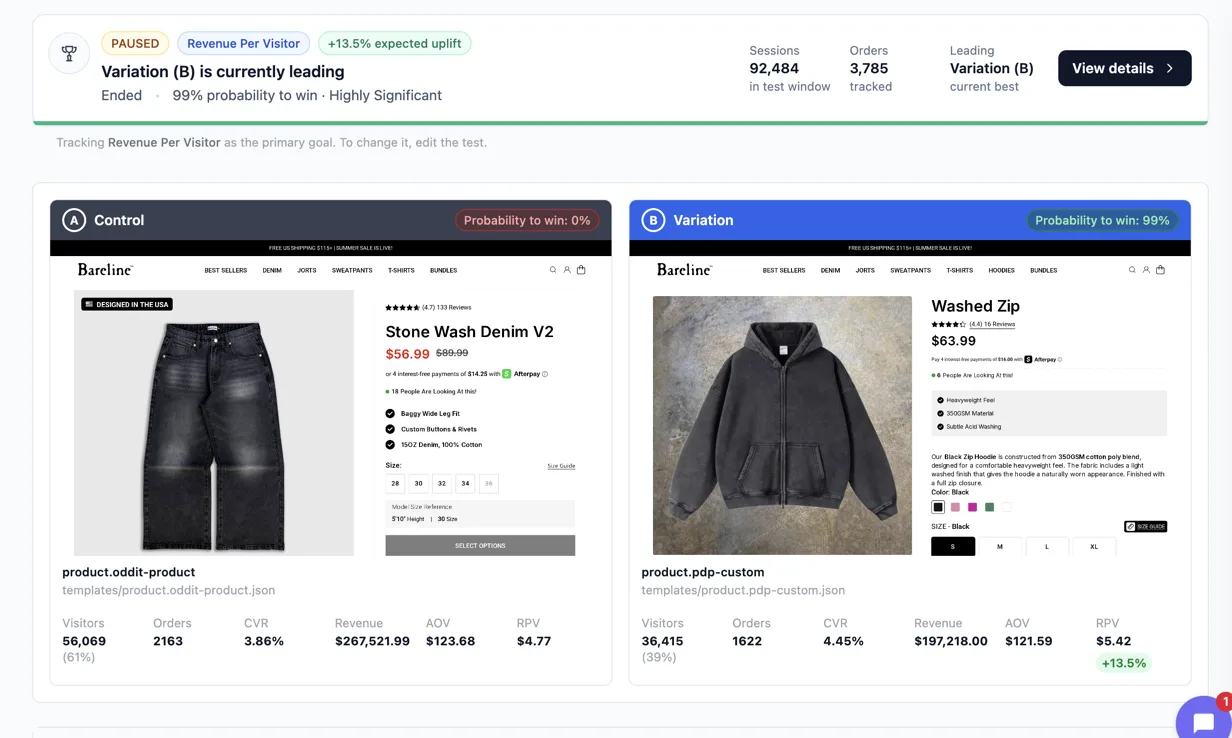
Sonic Brush rebuilt the product page itself, our PDP against theirs, Google Ads traffic, ABConvert, and came back +24%. Bareline tested our PDP template against their own PDP template across their sitewide product traffic on Eraya, 99% probability to win across 92,484 sessions, for +13.5%.
Read the confidence, not just the lift
PIP Wellness tested a listicle style page against their control on Meta traffic, ABConvert, and revenue per visitor moved from $0.40 to $0.66, a 64% lift. Gum of Gods tested our offer page against their own offer page on Meta traffic and came back +97%. Prime Natural and Snuff Cup both posted lifts over 300%, and both ran on small samples, which is a direction worth acting on, not yet a settled result. Uncle Butch’s Fudge, Pure Path Shop, Habit Nest, and Legendary Car Care all landed smaller, real lifts between 10% and 32%, each read the same way, off the testing platform, on the brand’s own traffic.
The pattern across all of it is not that a rebuild always wins big. It is that the win gets measured the same way every time, against the brand’s real page, on their real traffic, reported honestly whether it comes in at 10% or 300%. That discipline is the whole guarantee behind the offer: a rebuilt page has to prove a 10% lift in a controlled test, or the money comes back. See the full set of results at /results, or read exactly what the guarantee covers at /guarantee.
See it on your own page.
We rebuild your highest-leverage page and prove the lift on your own live traffic. A 10% lift in conversion rate, or your money back.
Book a call