Product Page Testimonial Copywriting That Lifts Conversion Rate
Most product pages treat proof as a box to check. A star rating here, a pull quote there, a stat in bold somewhere above the fold. None of it works alone, because a number with no feeling attached reads as marketing, and a feeling with no number attached reads as marketing too. Product page testimonial copywriting that actually lifts conversion rate does one specific thing: it bridges the trial and the feeling, so the reader gets the credibility of a number and the believability of a real experience in the same breath.
Here is the pattern in its plain form. A stat on its own is a claim. A testimonial on its own is an anecdote. Put them next to each other, in that order, and each one fixes what is missing from the other. The stat says this is not one person’s opinion. The testimonial says this is not just a number on a slide. Readers do not trust either in isolation anymore. They have seen too many inflated stats and too many stock quotes.
Why a flat stat reads as noise
A number with no texture around it gets skipped. “93% of customers saw results” is a sentence shoppers have been trained to scroll past, because it could mean anything and it asks for trust it has not earned. The fix is not a bigger number. It is attaching the number to a specific, sensory, first person account of what hitting that number actually felt like.
This matters more on a product page than almost anywhere else on a site, because the visitor arrived skeptical by default. They came from an ad. They do not know the brand. The proof section is the one place on the page where the reader is actively looking for a reason to doubt you, so it is the worst possible place to lean on a bare percentage.
The trial to feeling bridge, built correctly
The bridge has two parts and an order. First the hard number, stated plainly, with its source named if you have one (lab result, survey size, A/B test, whatever is real). Then, directly after it, one sentence of lived experience that could only have been written by someone who actually used the thing. Not “I love this product,” which could be written about anything. Something specific: what changed, what they noticed first, what they stopped doing because of it.
The stat earns the right to be believed. The story earns the right to be felt. Cut either half and the section stops converting.
A few rules that keep this from collapsing into the generic version every competitor already runs:
- Never invent the number. If you do not have a real stat, the section should be a strong qualitative testimonial and nothing else, dressed as exactly that.
- Never invent the testimonial. A fabricated quote is the single fastest way to lose a founder’s trust in your work, and it is usually the first thing they check.
- Keep the stat and the story about the same thing. A stat about speed paired with a testimonial about taste is two separate claims wearing one costume.
- Put the strongest version of this pairing above the fold or in the first scroll. Weaker proof can live further down. A page with thin proof should be shorter, not padded with filler testimonials to look busy.
Where this sits in the proof stack
This bridge is a copy technique, not a substitute for having real proof to work with. The strongest things a brand can show, roughly in order of weight, are a founder story or credible association, a real ambassador roster, a genuine clinical result, third party certification, and then volume and review proof. The trial to feeling bridge is how you write whichever of those you actually have. It does not manufacture proof that is not there.
What it does fix is the single most common failure mode on product pages we rebuild: proof that is technically present but reads as filler because it never connects to anything concrete. A rating badge floating with no story behind it. A stat in a callout box that nobody explains. The fix is almost always the same, take the number you already have and write one sentence of real experience next to it.
What this looked like in a real rebuild
On Eiyan Lens, an eyewear brand, we rebuilt the page around an offer structure instead of a plain product description, and paired the proof section’s numbers with specific first person framing throughout rather than a wall of star ratings. Tested against their home page on Google Ads traffic through ABConvert, the rebuild lifted revenue per visitor by +52%.
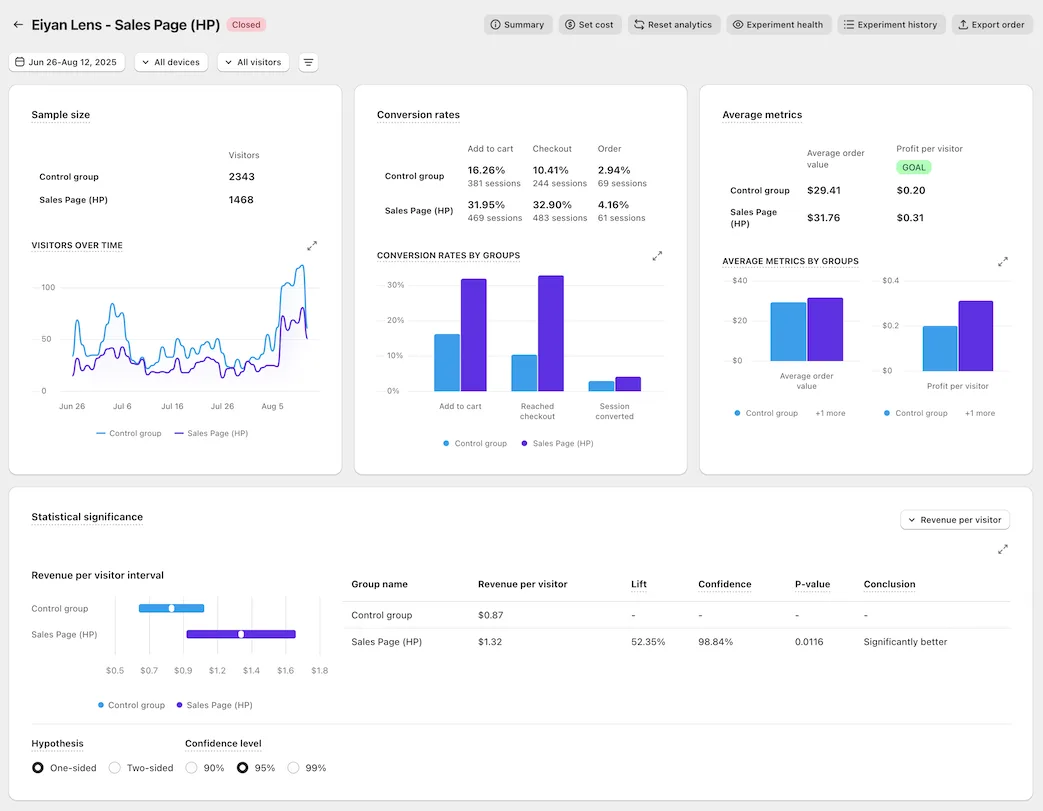
Revenue per visitor is the number that matters here, not just conversion rate, because a proof section can lift conversion rate by making the page feel more convincing while the brand quietly loses money if that same page is now selling the cheapest item to everyone. Revenue per visitor holds both numbers at once, which is why it is the metric we check before calling any rebuild a real win.
A short version you can use today
If you want to test this on your own page without a full rebuild, pull the single testimonial you already have that is the most specific, the one with an actual detail in it rather than “great product, fast shipping.” Put your strongest real stat directly above it. Nothing else. No redesign, no new section, just that pairing placed where your current proof lives. If conversion rate does not move, the problem is probably further up the page, not in this section, which is worth knowing either way.
We test this exact pairing, along with the rest of the page, as part of every rebuild we run. You can see the full set of measured results on /results, or read how the guarantee works on /guarantee if you want to know what happens when a test does not win.
See it on your own page.
We rebuild your highest-leverage page and prove the lift on your own live traffic. A 10% lift in conversion rate, or your money back.
Book a call