
Product Page Copywriting: The Cost Replacement Math
Most product page copywriting that increases conversion rate does it by removing friction. The cost replacement anchor does something different. It adds a number, a big one, and lets the buyer do the subtraction themselves.
What a cost replacement anchor actually is
A cost replacement anchor is not a discount. It is an itemized list of what a customer would have to buy separately to get the same result your one product delivers, each piece priced, totaled, and set next to your price. The gap between the two numbers is the argument. You never have to say the product is a good deal. The buyer does the math and arrives there on their own.
This only works on a specific kind of product: one that is genuinely replacing several things at once. A single serum does not get a cost replacement anchor, there is nothing to itemize against it. A skincare routine that folds a cleanser, a moisturizer, and a treatment into one step does. A gummy that stacks several supplements into one serving does. A device that replaces a subscription does. If the product is not actually doing the job of several products, the anchor reads as padding and a sharp reader will feel the stretch.
Product page copywriting that increases conversion rate starts with subtraction, not addition
Most pages try to build desire by adding claims. More ingredients, more features, more adjectives. The cost replacement anchor works in the opposite direction. It subtracts complexity: instead of asking the buyer to evaluate five separate purchase decisions, it collapses them into one decision they have effectively already made, since they were going to buy some version of all five anyway.
The order matters. State what the product replaces before you state its price. If price comes first, the anchor reads as a justification after the fact, something tacked on to make an expensive thing feel cheaper. If the itemized list comes first and the price follows, the price reads as the punchline of math the reader just did themselves.
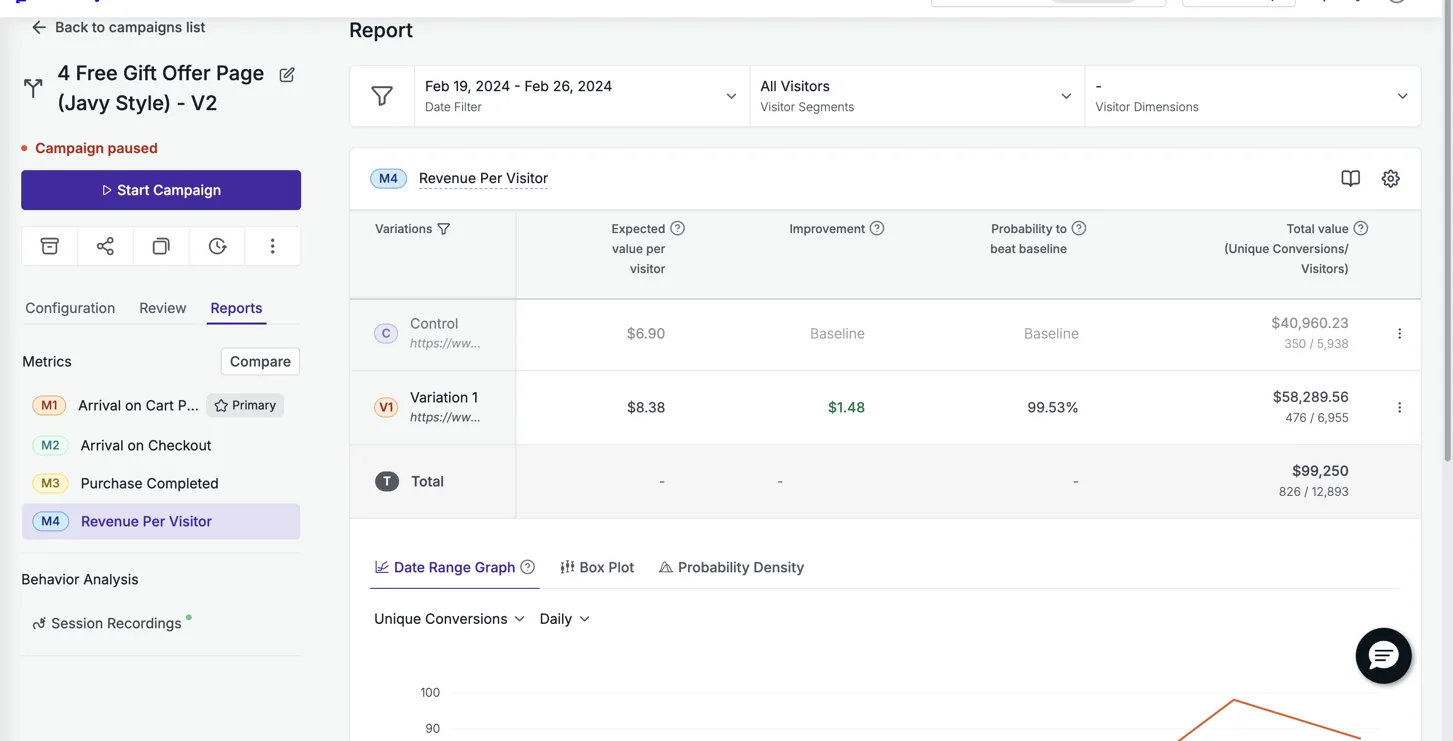
Particle for Men is a clean example of a page built around this kind of reframe, an offer that states the simplification rather than the category. Tested as an offer page against their standard product page on 12,893 visitors at 99.5% confidence, it lifted revenue per visitor 21.4%, and it is still live two years later, which is its own kind of proof: a page that only won by accident does not survive a rebuild cycle, let alone two years of real traffic.
Build the list from real numbers, not invented ones
The itemized list has to be defensible. Price each component at what it would genuinely cost to buy on its own, from a real source, not an inflated placeholder. The moment one line item looks invented, the whole page loses credibility, including the parts that were true. If you cannot price a component honestly, leave it off the list rather than guess.
Three rules keep the anchor honest:
- Price each item at what a shopper would actually pay elsewhere, not a rounded up guess.
- Total the list before you show the product price, so the gap is visible before the ask.
- Never let the anchor replace your real struck through price. They are two different arguments, run both.
A cost replacement anchor only works once. If the reader catches one invented line item, every number on the page becomes suspect, including the ones you measured.
Why this moves revenue per visitor, not just conversion rate
A cost replacement anchor can lift conversion rate on its own, simply by making the product feel cheaper relative to the alternative. That is not the same as proving it worked. A coupon lifts conversion rate too, and quietly loses money per order. The way to tell the difference is to read the result in revenue per visitor, which holds conversion rate and average order value together: if the anchor is doing real work, more people buy and the order value holds, so revenue per visitor rises along with conversion rate.
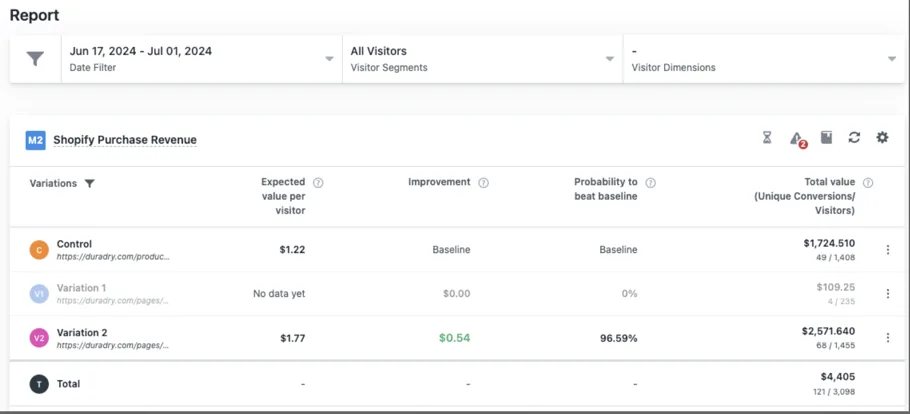
DuraDry ran this kind of offer page against their standard product page on Google Ads traffic, tested on VWO over two weeks, and lifted revenue per visitor 45%. That is the shape you want from this lever: a page built around what the product replaces, read on the metric that cannot be fooled by a discount.
Where this lever does not belong
Do not force a cost replacement anchor onto a product that only does one job. A single accessory, a single flavor of a simple consumable, a product with no real substitutes to list against it, none of these have a case to make. Trying anyway produces a page that argues against a straw man, and shoppers notice when the comparison feels built rather than found. Save the lever for the product that is genuinely doing the work of several, and let the math speak once it has something true to say.
We have run this kind of offer architecture across many of the 400+ ecommerce brands we have worked with, and it is one of a short list of levers we check for on every rebuild, alongside the proof stack and the hero reframe. The full set of measured results, with the methodology behind each one, is on /results. If you want to know what your own guarantee looks like before you commit to a rebuild, that is covered on /guarantee.
See it on your own page.
We rebuild your highest-leverage page and prove the lift on your own live traffic. A 10% lift in conversion rate, or your money back.
Book a call