
Cost Replacement Anchor Copywriting for Shopify
A customer does not weigh your price against zero. They weigh it against the version of this they would have assembled themselves, piece by piece, at retail. Cost replacement anchor copywriting for Shopify is the practice of doing that math for them, in public, before you show the number they actually pay. Get the itemization right and the price stops being the ask. It becomes the deal.
Most product pages skip this step entirely. They show a product, a price, a buy button, and expect the visitor to intuit that the price is fair. It is not the visitor’s job to build that case. It is the page’s job, and on a lot of products it is the single highest leverage block you can write.
What the anchor actually does
The mechanism is simple and it is not discounting. You list what the customer would need to buy separately to get the same outcome your product delivers in one purchase. Each item gets its own price. You total the list. Then, and only then, you show what your product actually costs.
The gap between the total and the real price is the story. It is not “20% off.” It is “here is what this would have cost you to piece together, and here is what it actually costs.” That framing does something a percentage discount cannot: it makes the buyer do the comparison math themselves, in their own head, and land exactly where you wanted them to land.
This only works on a product that genuinely replaces several things. A single skincare serum does not replace five products unless it actually does the job of five products. A subscription gummy that replaces three supplement bottles can say so, as long as it is true. The anchor is a transparency play, not a sleight of hand, and it breaks the moment a reader can tell the comparison was invented to make a number look bigger.
Cost replacement anchor copywriting for Shopify, step by step
The formula is the same whether you are selling a skincare routine, a supplement stack, or a grooming system. In order:
- Catalogue what the product actually replaces. Be literal. If a customer would otherwise buy three separate items to get this result, name the three items.
- Price each one at what it actually costs. Use real retail prices for comparable products, not invented ones. A reader who senses a made up number stops trusting the whole page.
- Total it, visibly, before the real price appears. The order matters. The itemized total has to land first, so the actual price reads as a relief rather than a reveal.
- State the real price once, cleanly, with no further selling on top of it. The math already did the selling. Over explaining it after the total undoes the effect.
- Repeat the unit economics nearby. Price per use or price per day, shown beside the total, shrinks the number further without adding another argument.
This is the stack value principle from our own build process: itemise what comes free or what gets replaced, price each piece, and total it against the ask. A deeper discount is a weaker move than a wider stack, because a discount only argues about your price. A stack argues about the customer’s alternative, which is the comparison that actually decides the sale.
Where the proof is, and what it actually tested
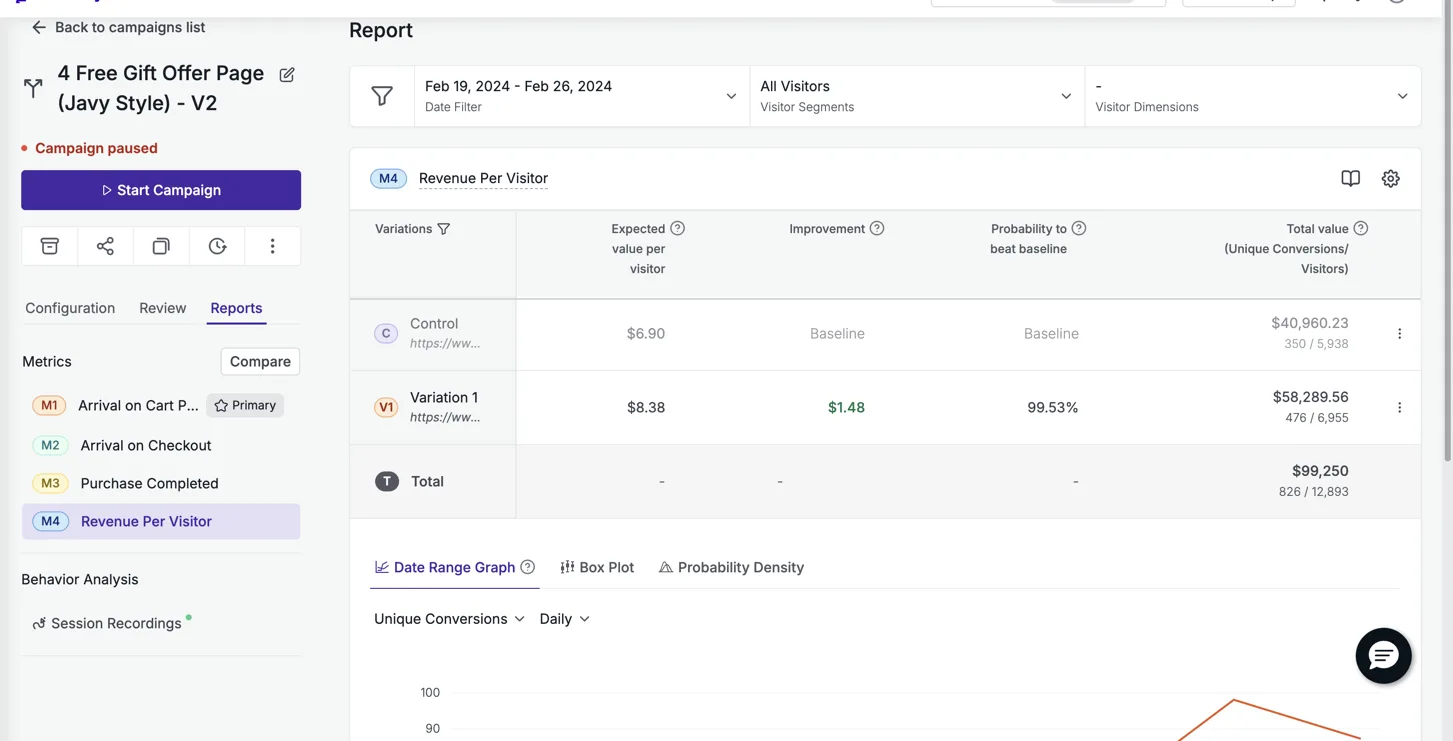
We do not publish this kind of mechanism without a number behind it. Across our measured rebuilds, Particle for Men ran an offer page against their own product page on VWO, and the offer page won by +21.4% revenue per visitor at 99.5% confidence across 12,893 visitors. That page is still live two years later, which is its own kind of proof: a page built on real math holds up under real traffic, it does not need to be refreshed every quarter to keep winning.
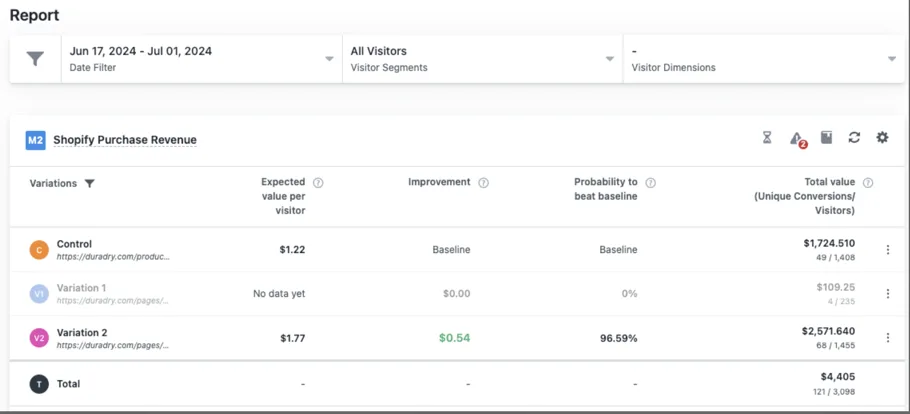
DuraDry, a sweat care brand, ran a similar offer page against its product page on Google Ads traffic, tracked in VWO over a two week test, and the offer page won by +45%. That is a bigger number on a shorter window, and it is worth saying plainly: a two week result is a real result, not a guess, but it has not had the time to prove it holds the way Particle’s two year run has.
Neither number proves the anchor formula on its own, because an offer page rebuild changes more than one thing at once. What they prove is that offer page structure, built around a real stack and a real comparison, consistently beats a plain product page on the metric that actually matters: revenue per visitor, not conversion rate alone, because revenue per visitor cannot be gamed by a discount the way conversion rate can. The full case set, with methodology attached to every number, is on /results.
Where it works, and where it quietly fails
The anchor is strongest on consumables, subscriptions, and anything that bundles a routine into one purchase. It is weakest on a single, simple, standalone product with no natural stack to compare against. Forcing the formula onto a product that does not replace anything produces a page that argues against itself, listing comparisons a sharp reader can tell were manufactured for the occasion.
The other failure mode is the struck through price. If the reference price you show is not a real price anyone could have paid, the whole page loses credibility the moment a visitor notices, and once a visitor stops trusting one number on the page, they stop trusting all of them.
The itemized total has to land first, so the real price reads as a relief, not a reveal.
If you want this built into a page and tested against your own traffic rather than argued about in the abstract, that is the whole premise of our guarantee: a 10% lift in revenue per visitor in a controlled test, or your money back. Details are on /guarantee.
See it on your own page.
We rebuild your highest-leverage page and prove the lift on your own live traffic. A 10% lift in conversion rate, or your money back.
Book a call